MoreExam
1. Question Content...
EXPLANATION
Answer: X - EXPLANATION Content.
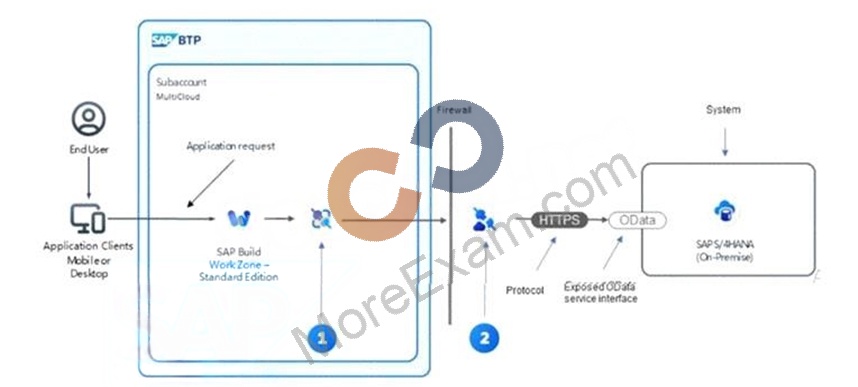
Question1: A customer wants to establish connectivity between applications being executed by end users and the on- premise backend system (SAP S/4HANA).Based on the attached diagram, which combination is necessary to establish the connectivity?
Question2: A fit-to-standard analysis determined that the provided SAP Fiori App for SAP S/4HANA Cloud private edition was insufficient based on existing business requirements, and that a new front-end app must be built.As a solution architect, you are asked to propose a solution and are told the following:*The backend logic running on SAP S/4HANA Cloud private edition is sufficient and an appropriate remote API for create, read, update, and delete (CRUD) operations exists.*The front-end app must be able to run on a variety of devices such as mobile phones and tablets.*Front-end app instances must scale up or down automatically based on administrator- provided scaling parameters.Which of the following runtimes would be optimal for the new front-end app? Note: There are 2 correct answers to this question.
Question3: A company is decommissioning its legacy ERP system in favor of adopting SAP solutions. The company is not sure which specific solutions to adopt. The company has three main business goals:*Maintain several unique business processes.*Maintain the solutions with a small budget, and limited time and resources.*Integrate several non-SAP solutions.Which combination of solutions should the customer adopt?
Question4: A company is implementing SAP S/4HANA Cloud along with SAP BTP. They need a customer-facing application for the general public. The application also needs to use its own unique SAP BTP subdomain. As a solution architect, you have been asked how a unique domain name can be accomplished.Which of the following can serve as an option? Note: There are 2 correct answers to this question.
Question5: A client's IT department has half a dozen subaccounts. They are having problems with the administration of the subaccounts as well as the corresponding global account.Which SAP BTP service would you recommend to the customer, to design and develop a custom application to perform their administrative tasks?
Question6: A customer wants to design and build a mission critical application:*The app will undergo frequent adjustments because business and legal changes will occur often.*The application must be always ready for deployment to production.*The deployment to production will be done manually by the IT department.*Changes to the application code must be merged smoothly and easily so that the code remains stable.As a solution architect, which SAP BTP solution best meets the customer requirements?
Question7: A company is struggling with organizing and managing the immense amount of data generated by the business. They have been told about several possible solutions that SAP BTP offers; however, they are confused about which solutions they should use. A large amount of their historical and current data is in comma-separated values (CSV) and JavaScript Object Notation (JSON) documents. These documents need to be stored for reporting purposes. The client prefers to use the latest SAP solutions.Which SAP BTP solution would you recommend?
Question8: The finance department is creating a series of reports for their line of business (LOB) users and would like to integrate the reports in a front-end portal. They would like the LOB users to maintain the portal, as opposed to IT. As a solution architect, they come to you to recommend which SAP BTP service best fits their needs.Which service would you recommend?
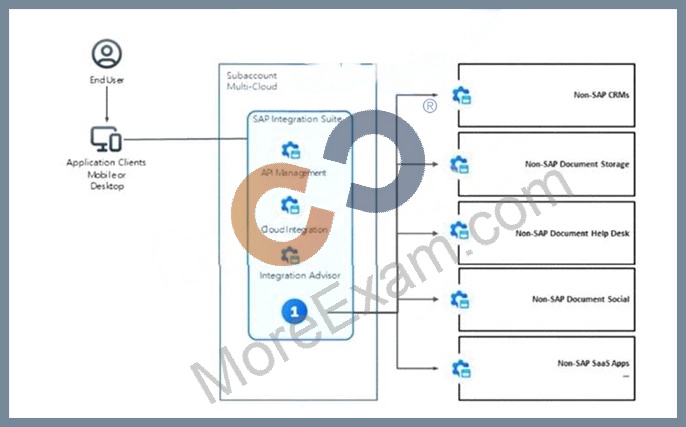
Question9: The following design (see attached diagram) uses third-party REST APIs that are publicly available through the internet.Which capability of the SAP Integration Suite can be used in place of "1" in the diagram?
Question10: A manufacturer wants to discuss the design of a solution that tracks and manages stock availability and movement of goods within a warehouse. They want to ensure that movements are aggregated for reporting purposes and that these reports can be used to optimize stock movements. They also want to use the newest solutions to build these reports.Which of the following solutions can be used together to fulfill the requirements? Note: There are 3 correct answers to this question.
Question11: Which of the following are process steps in serving up a model in SAP AI Core? Note: There are 2 correct answers to this question.
Question12: Which part of the SAP Al architecture is responsible for handling text input from end users?
Question13: As a solution architect, you are asked for your opinion on an optimal integration. You are told that the data resides in two places, SAP S/4HANA (on- premise) and third party APIs. You are also told the following requirements:*Periodically read the data from both systems, perform several transformations of the data, and forward the results to a business partner.*Monitoring is to be done by a dedicated group from IT with SAP products.*Maintenance of the integration part has a small budget, limited time, and limited resources. Which of the following solutions would you recommend as optimal for the design?
Question14: Company XYZ, a global firm with 25K+ employees across the geographic locations Europe (headquarters), the USA (manufacturing), and South America (procurement), is migrating to SAP S/4HANA using SAP BTP.Each geographic location has dedicated IT staff managing access, authorizations, and SAP BTP resource quotas. For cost control, the company aims to analyze and optimize the usage and cost of SAP BTP resources both globally and by geographic location, intending to enhance their SAP BTP Account model structure.Which of the following SAP BTP account models are appropriate? Note: There are 2 correct answers to this question.
Question15: You have been hired as a solution architect and it's your first day on the job. You participate in a meeting discussing the design and development of an extension to SAP S/4HANA Cloud. In the meeting, you are told:"We have determined that the BusinessPartner (A2X) API in SAP S/4HANA Cloud is insufficient for our needs. Fortunately, the API is extendable via key user extensibility. We are currently creating a diagram with the technical building blocks of the extension".In which SAP Application Extension Methodology phase is the project?
Question16: A customer is struggling with organizing and managing the immense amount of data generated by the business. They have been told about several possible solutions that SAP BTP offers; however, they are confused about which solutions they should use. Their data is highly structured and includes customers, sales orders, and purchase orders. The data needs to be stored for both transactional and reporting purposes in a vector database. The client prefers to use the latest SAP solutions.Which of the following SAP BTP solutions would you recommend?
Question17: You are a solution architect on a brownfield project where an SAP ECC 6.0 system is being migrated to SAP S/4HANA Cloud public edition. Two mission- critical legacy applications must be migrated to the new system.There is some debate on the project team as to the appropriate programming model to use:*Application 1 was originally written using classic ABAP. The underlying SAP tables that the application originally relied on have been removed and the data now exists in a new simplified table in SAP S/4HANA Cloud public edition (to which table extensions are not permitted). Additional data needed for the application resides in SAP Ariba. Remote interfaces exist for both to select the data.*Application 2 was originally written using Java and relied upon tables from the SAP ECC 6.0 system as well as SAP PLM 4.0. The PLM system will be retired; however, the SAP S/4HANA Cloud public edition instance has all the data needed for the application. No remote interfaces exist to select the data.Which of the following approaches should the customer use? Note: There are 2 correct answers to this question.
Question18: You are a solution architect assigned to a customer business transformation project.Which solutions would you recommend the customers adopt to analyze and to optimize their procurement process to exceed industry benchmarks? Note: There are 2 correct answers to this question.